
Home › Products › uPVC Conduit Pipe
uPVC Round Conduit Pipe
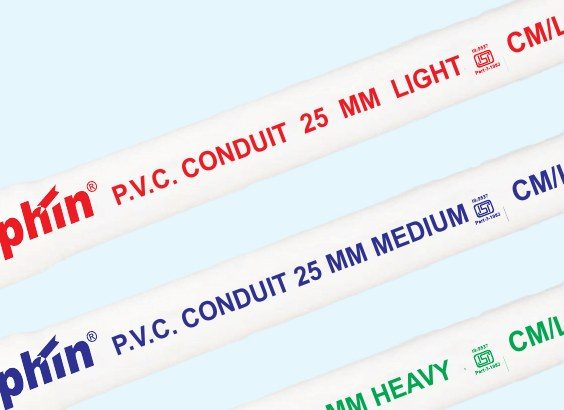
Rigid unplasticised PVC conduit for concealed and surface electrical wiring. Light, medium and heavy grades, 20 mm to 50 mm, ISI marked to IS:9537 (Part 3) – 1983.
Product overview
Conduit that survives the wall
Dauphin conduit is extruded on twin-screw machinery from a rigid uPVC compound with minimum filler. That combination is what gives it high impact strength — it takes the knocks of laying, bending and plastering without cracking.
- Self-extinguishing, rated UL94 V-0
- Working temperature up to 70 °C
- Non-corrosive — no rust, no earthing continuity worry
- Far more economical than steel conduit, and much faster to install
- Dimensioned to suit standard concealed wiring practice to IS and BS
Dimensions · IS:9537 Part 3
Every size, every grade
Minimum internal diameter decides how much cable you can pull. Pick a grade to highlight its column.
| Nominal size | Max O.D. | Min O.D. | Minimum internal diameter | ||
|---|---|---|---|---|---|
| Light | Medium | Heavy | |||
| 20 mm | 20.00 | 19.70 | 17.40 | 16.90 | 15.80 |
| 25 mm | 25.00 | 24.60 | 22.10 | 21.40 | 20.60 |
| 32 mm | 32.00 | 31.60 | 28.60 | 27.80 | 26.60 |
| 40 mm | 40.00 | 39.60 | 35.80 | 35.40 | 34.40 |
| 50 mm | 50.00 | 49.50 | 45.10 | 44.30 | 43.20 |
| Nominal size | Tolerance on O.D. | Metres per bundle |
|---|---|---|
| 20 mm | −0.30 mm | 120 m |
| 25 mm | −0.40 mm | 75 m |
| 32 mm | −0.40 mm | 45 m |
| 40 mm | −0.40 mm | 45 m |
| 50 mm | −0.50 mm | 30 m |
Current MRP for every size and grade is in the price list — download it here.
Three ranges
ISI, Premium and Economy
Not every job is specified the same way. We make an ISI-marked range for anything that will be inspected, a Premium range built to a stated wall thickness, and an economy range for price-driven work.
PVC Conduit — ISI
The standard range, ISI marked to IS:9537 Part 3 under licence CM/L-9512401719. Specify this for tenders, government work and anything that will be inspected.
Sizes 20, 25, 32, 40, 50 mm
Grades Light (20–32 mm), Medium, Heavy
Length 3 metres
PVC Conduit — Premium
Also ISI marked, but supplied against a stated minimum wall thickness rather than grade alone — useful where a specification calls out wall thickness directly.
20 mm MMS wall 1.50 mm and above
25 mm MMS wall 1.60 mm and above
25 mm HMS wall under 2.00 mm
32 mm MMS available
Non-ISI PVC Pipe
An economy range for price-sensitive work. This range is not ISI marked and should not be offered where a specification, tender or inspection requires ISI-marked conduit.
19 mm Economy, Normal, Premium
25 mm Economy
Grades Light, Medium, Heavy by variant
Length 3 metres
Technical properties
Tested characteristics
Mechanical
Compression under specified load
less than 25%
Compression without load
less than 10%
Tensile strength
390–420 kg/cm²
Impact strength
High
Electrical
Dielectric strength
36 kV/mm
Specific resistance
6.0 × 10¹⁴ ohm cm
Electric strength
No breakdown at 2 kV, 50 Hz for 15 minutes
Thermal
Working temperature
70 °C
Burning rate
Self-extinguishing
Flammability
UL94 V-0
Flame die cut time
less than 30 seconds
Other lengths and custom printing available for bulk requirements. Contact us for project schedules.
Questions we get asked
Conduit pipe FAQs
Practical answers for specifying and installing uPVC conduit.
What is a uPVC conduit pipe used for?
It is a rigid plastic tube that carries and protects electrical cable inside a building. The wiring runs through the conduit rather than being buried loose in plaster, which shields it from being nicked by a nail, chewed by rodents, or damaged when a wall is drilled years later. It also means a circuit can be rewired later by pulling new cable through the same route, without breaking the wall open.
Should I use light, medium or heavy grade?
The grades differ in wall thickness, and so in how much impact they take. Light grade has the largest bore for a given size and suits protected runs with lighter mechanical duty. Medium is the usual choice for domestic and commercial concealed wiring — it is what most specifications call for. Heavy has the thickest wall and the smallest bore, and is specified for industrial work, buried runs and anywhere the pipe may take a knock.
What size conduit do I need?
It depends on how many conductors run through it and their cross-section. As a rule the cable should not fill the bore so tightly that it cannot be pulled through, and a run with several bends needs more slack than a straight one. Our dimension chart gives the minimum internal diameter for every size and grade, which is the figure to work from. If you tell us the circuit, we can advise what to specify.
What is the difference between PVC and uPVC conduit?
uPVC is unplasticised — no plasticiser is added to soften it. That keeps the pipe rigid and holds its mechanical strength over time, which is what you want in a wall. Plasticised PVC is more flexible but softer, and it can deform under sustained load or heat. Conduit to IS:9537 Part 3 is rigid, unplasticised material.
Can conduit be cast into concrete or buried in a wall?
Yes — that is its normal use. It is fixed in place with clamps or tied to reinforcement before the plaster or pour, so it does not shift. Because uPVC does not corrode, a concealed run does not deteriorate the way steel conduit can where damp gets in.
How are conduit lengths joined?
Straight lengths are joined with a socket, and direction changes are made with a formed bend rather than by heating and bending the pipe on site — a site bend usually flattens the bore and makes pulling cable harder. Junction boxes are used wherever conductors are joined or a branch is taken, so that connection stays accessible afterwards.
Can uPVC conduit be painted?
Yes. Surface runs and casing n caping take paint readily once the surface is clean and lightly keyed, so exposed work can be finished to match the wall.
Why use conduit instead of running cable directly in the plaster?
Cable laid straight into plaster has nothing between it and the wall. Any later drilling, settlement crack or damp patch reaches the insulation directly, and rewiring means chasing the wall out again. Conduit costs a small fraction of a wiring job and removes all of that.
Is uPVC conduit better than steel or GI conduit?
For most building wiring, yes — and it is considerably cheaper. It does not rust, needs no earthing continuity across joints, weighs far less, and installs much faster. Steel still has a place where extreme mechanical protection or specific fire requirements apply.
What length does conduit come in?
Standard length is 3 metres. Other lengths, and custom printing, can be produced for bulk requirements.
Is Dauphin conduit ISI marked?
Yes. It is manufactured under BIS licence CM/L-9512401719 against IS:9537 (Part 3) – 1983. The size, grade and licence number are printed along every length, so material can be identified and verified on site.
Do you supply to dealers and projects?
Yes. We supply distributors, retailers, electrical contractors and project buyers, with truckload despatch from our factory at Hansi in Haryana. Send us the sizes, grades and quantity along with the delivery location and we will come back with rates and despatch time.
Need rates for a specific size?
Send us the sizes, grades and quantity, and the delivery location. We'll come back with rates and despatch time.